
Showing posts with label Wet Noodle Nib. Show all posts
Showing posts with label Wet Noodle Nib. Show all posts
Saturday, October 19, 2019
Flexy Nib Fountain Pens Compilation
Just a smattering of flexible vintage nibs, for fun! Yes, I wasted ink. Yes, I use my vintage pens. Yes, I have fun doing this. Please do not panic about how much ink is being used. It's insignificant compared to the amount in a bottle. Just enjoy the inky close-ups!

Saturday, July 8, 2017
Just the Basics: Using a Flex Nib Fountain Pen [Video]
Just a short little video to explain how I use a flex nib - when and where to apply pressure and what can happen while you use it (railroading, feed touching the page). I hope this is a little helpful!
Saturday, October 4, 2014
Tilburg Pen Show 2014 - Good Times & Haul
The Tilburg Pen Show was great. It was only one day, but to be honest, I don't think I could have handled a second day because by the end of the day, I had lost my voice. The show was fun because I spent time chatting with pen pals, new pals, vendors, and I spent even more time drooling over pens.
My list wasn't all that extensive and I quickly eliminated a few options because they just weren't anywhere to be seen. Others, such as the Waterman 94 on my list, was something I scoured for... but you know when you fall in love with one in particular? Anyway. That happened. We arrived early and went for coffee before the show started, stopped by La Couronne du Comte (pictures of the store will come in another post!), and entered the show promptly at 11:02 a.m. It opened at 11:00 a.m. Two minutes late...

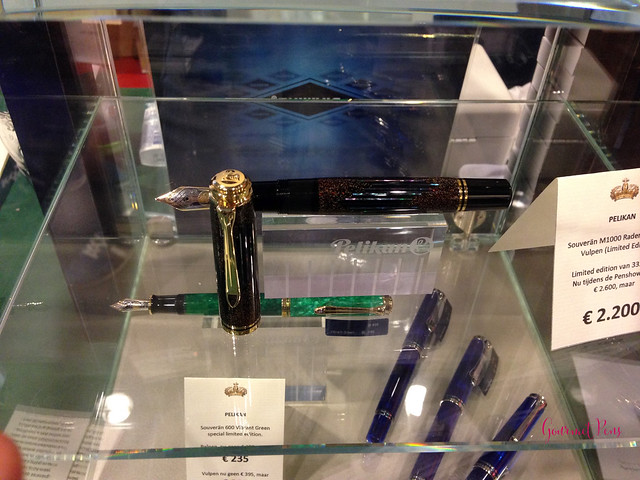
 La Couronne du Comte brought a stunning Pelikan M1000 Raden Starlight... and it was 600 euros off! Alas, still out of my price range.
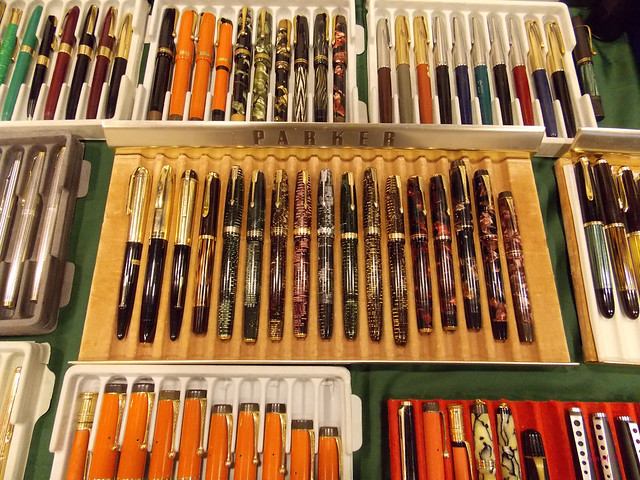
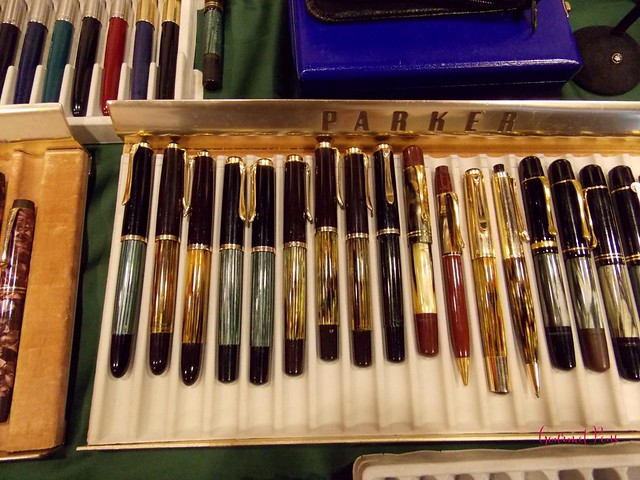
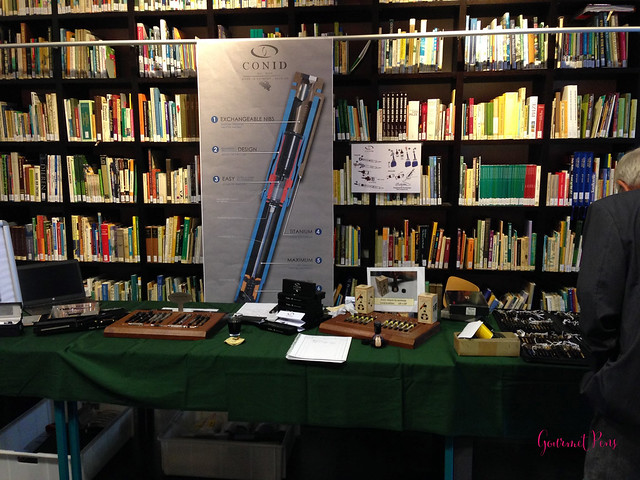
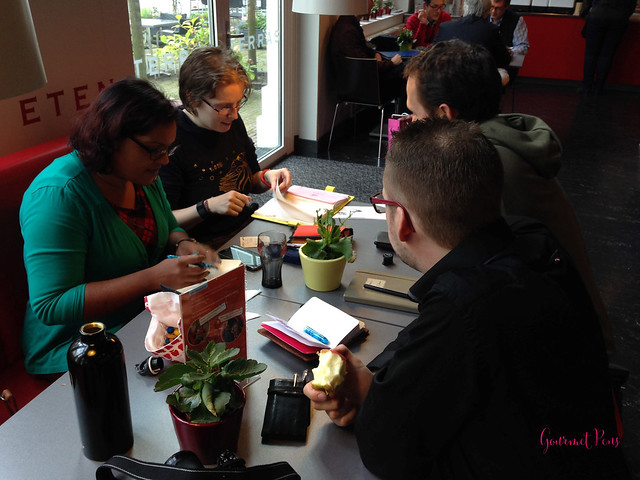
A short break for lunch and snacks - and for trying each others' pens! It doesn't get much better than that.
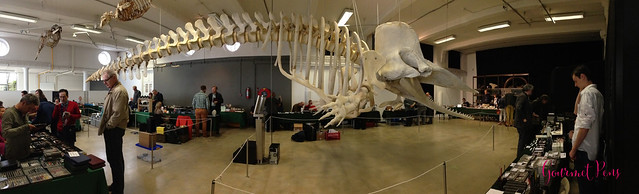
This is a really cool venue! At least for me. I took a panorama of the bigger room - with vendors surrounding the skeleton in the center.
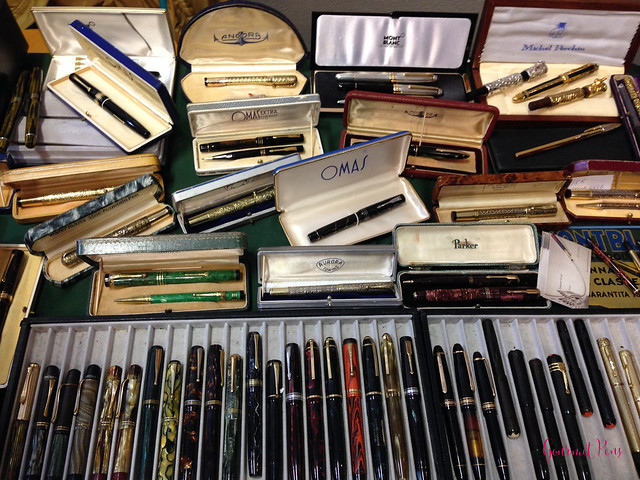
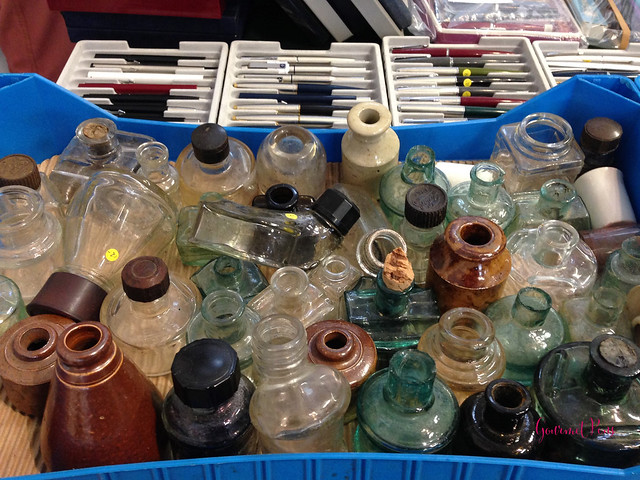
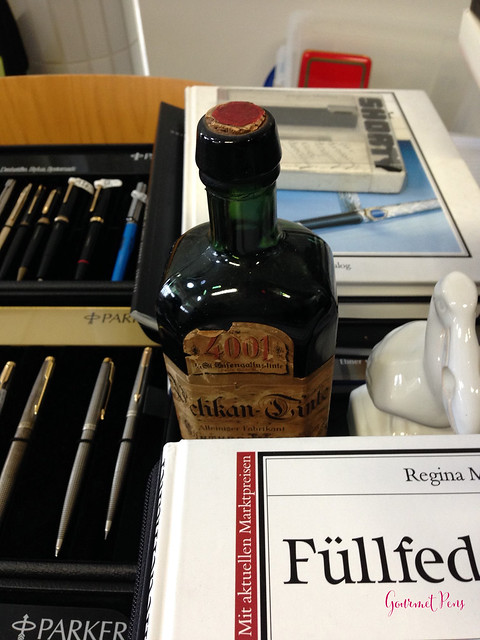
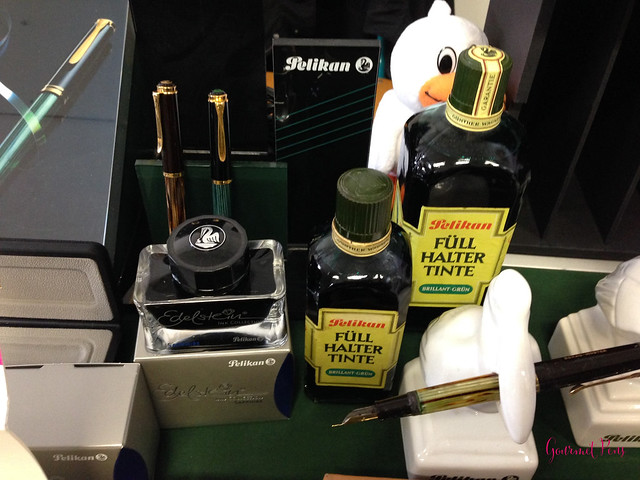
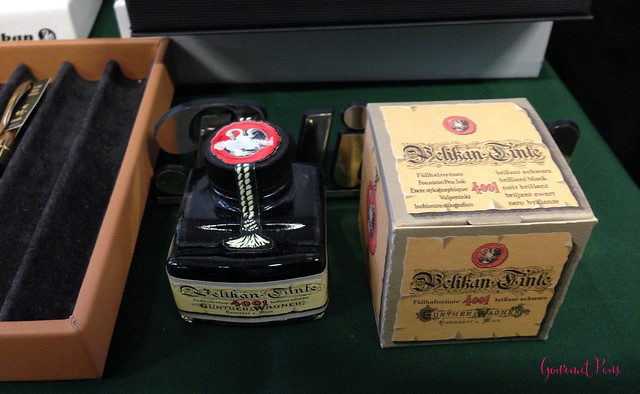
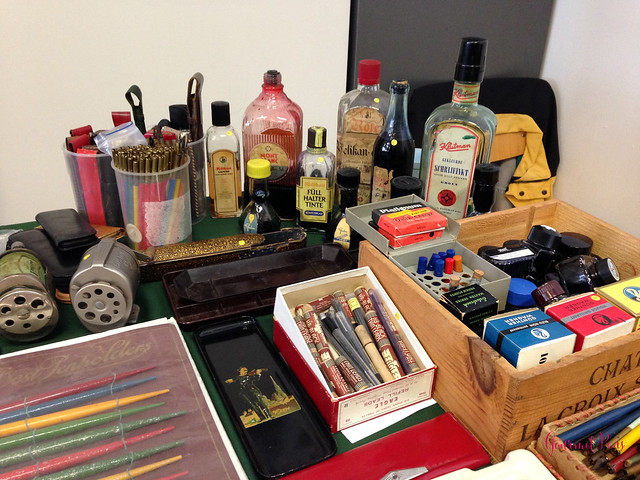 You can find all sorts of things, including bottles. Empty bottles, that is.
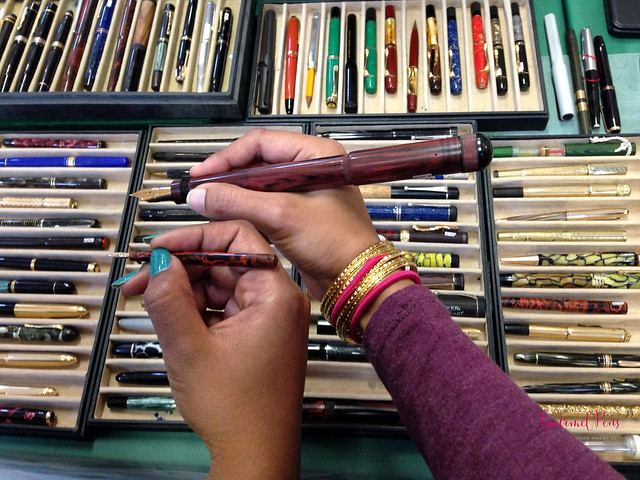
My list wasn't all that extensive and I quickly eliminated a few options because they just weren't anywhere to be seen. Others, such as the Waterman 94 on my list, was something I scoured for... but you know when you fall in love with one in particular? Anyway. That happened. We arrived early and went for coffee before the show started, stopped by La Couronne du Comte (pictures of the store will come in another post!), and entered the show promptly at 11:02 a.m. It opened at 11:00 a.m. Two minutes late...
 |
| Maybe we need a selfie stick. |
A short break for lunch and snacks - and for trying each others' pens! It doesn't get much better than that.
This is a really cool venue! At least for me. I took a panorama of the bigger room - with vendors surrounding the skeleton in the center.
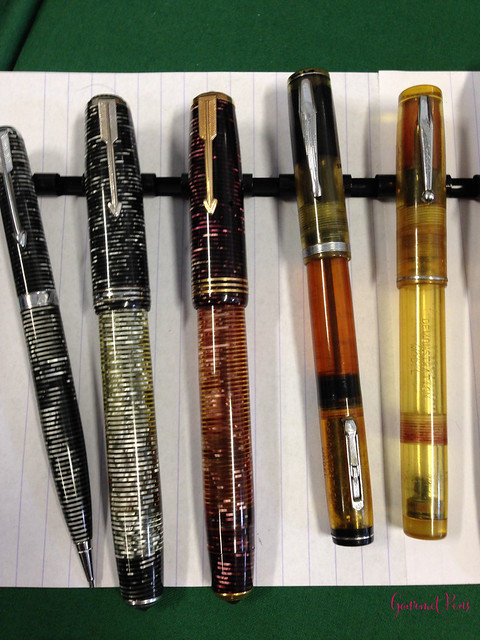
A really big pen and a really small pen!
Very unique pens - real demonstrator fountain pens - Waterman's glass cartridge demonstrator and ink filler. Extremely cool, steep prices.
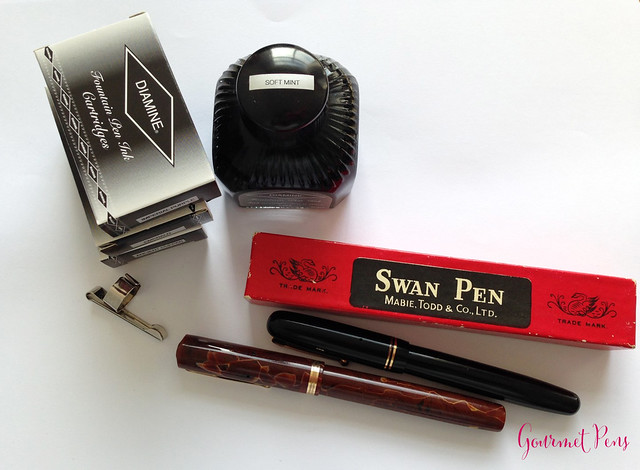
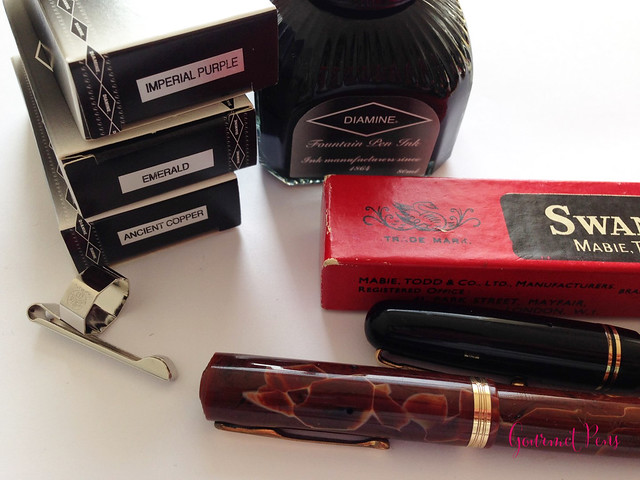
And now, for what I left with - a bottle of Diamine Soft Mint ink, a silver clip for my Kaweco Skyline (mint), three boxes of Diamine ink cartrides - Ancient Copper, Imperial Purple, and Emerald, a Mabie Todd Swan Self-Filler, and a stunning Waterman 94 with an insane #4 New York wet noodle nib. Obviously. Perfectly reasonable haul, right?
Friday, September 19, 2014
Two Tines, Three Tines: A Symphony of Music Nibs
What with the whisperings of the anticipated Noodler's Neponset music nib fountain pen, you may be thinking "umm...what the heck is a music nib?" and that's totally valid. I'm not a nibamagician, so I will refer to Mr. Binder's explanations for help here, so I don't muss it up. Here's a huge thank you to Mr. Binder for being an excellent resource. Hopefully you'll find this post helpful (and maybe a little bit enabling...)!
What Is A Music Nib?
Traditional music nibs have a broad stub tip with smooth edges. It's a nib that was made for just that: writing music. (Not composing it, mind you, just writing it down.) You'll notice that music has fat, filled in notes, and thin horizontal bars. The nibs are usually wet writers because this generous flow allows musicians to fill in those notes more easily and more quickly. Vintage music nibs were produced with two slits and three tines, and were flexible.
Two Tines, Three Tines?
Typically, we expect music nibs to have two slits and three tines because this offers a wetter flow and more line variation (wider stub), both needed for actually writing music, but this isn't a requirement, and it's possible to achieve such wetness and variation without three tines. The feeds for these nibs are often made specifically for these nibs as well, as in the case of the upcoming Noodler's Neponset, which has two slits to feed the nib with ink.
What's The Difference: Stub, Italic, Music?
A stub nib has a wider tip than a round tip, giving a wide vertical line on the down stroke and a thinner horizontal line on the side stroke. A stub is a smooth nib to use because the edges are polished, so it can be used easily by most.
An italic nib is wider than a stub nib and, unlike the stub whose edges are smooth and polished, the italic's edges are sharper. As a result, the broad vertical and thinner horizontal lines are more marked. Due to the sharp edges, one must write with some care and with the proper angle to make sure the nib is held straight on the paper, otherwise you'll experience skipping. With italic nibs, you get clean and precise thin and thick lines, but it's not as easy to use as a stub.
A cursive italic nib is the safe zone of an italic, if the sharp edges aren't for you. The tip of the cursive italic nib is wide like that of an italic, which will give the pronounced line variation you'll get with italics over stubs, with the slightly smoother edges of a stub nib. A safe compromise!
How Is A Music Nib Used For Music?
Music nibs are often used at very high angles relative to the paper, where down strokes would be thin, and side strokes would be the width of the nib. This is probably the opposite of what you expect from a stub/italic nib, whose down strokes are thick and side strokes are thin.
In addition, stubs/italics frequently have sharp corners and edges where the rounded bottom of the tines meet the flat top of the tip. If one tries to write music with an italic, rotating/holding the pen as musicians often do when scribbling notes and bars would dig into the paper.
True music nibs should have smoothed edges so the nib glides across the page, even if the pen is rotated, and at both high and low angles of writing.
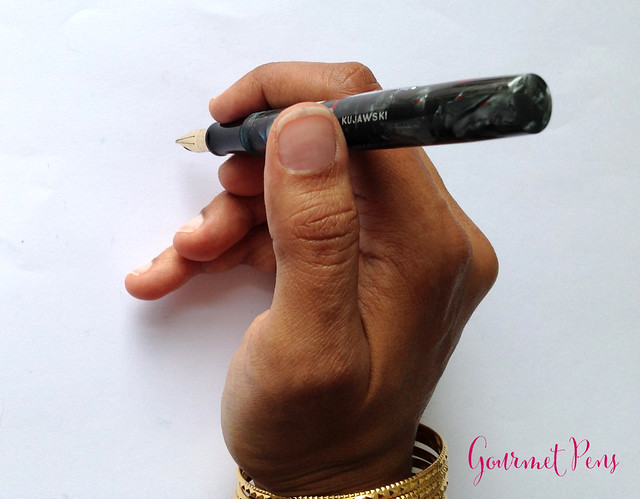 What surprised me was I had been holding my music nib all wrong for proper music composition (of course, I'm not using it for that, but still). The nib must be held at a high angle to the paper, and the nib is rotated so wide stroke is the horizontal/left-right stroke, as opposed to the vertical/up-down stroke, and the narrow stroke is the vertical/up-down stroke, as opposed to the horizontal/left-right stroke.
Flex Or Not?
If you've ever tried to write music, or even just draw notes, you'll notice it's a heck of a lot more difficult (and irritating) to try and draw them with a hard, unyielding nib. Music nibs with flexibility is a modification that allows the nib to flex on the pull stroke to widen/wetten/thicken notes and lines - such as notes and note bars. It may not be a requirement, but a nib without flexibility will hamper the ability to quickly and easily write music.
A nib without flexibility isn't less enjoyable though. They can still offer some great line variation and a wonderful writing experience, especially if you aren't using it for actually writing music.
Want A Music Nib?
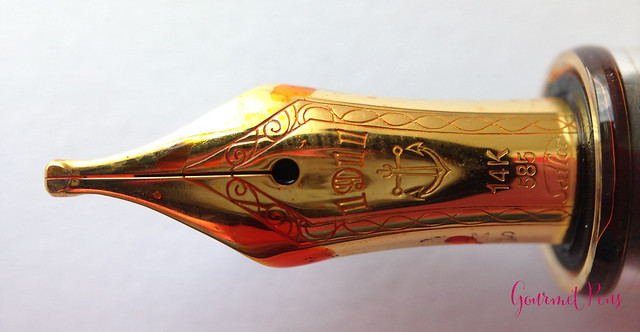 Modern: Sailor's 1911 music nib
 is a single slit, double tine music nib in 14K gold. This nib offers the wide stub needed for filling in notes, with the ability to draw thinner, horizontal lines for the note bars. It's also meant to be a wet writer. The tip of this nib is very stubby and even if you're not a musician, it offers a wonderful, expressing writing experience with bold lines. The edges are also fairly smooth so it doesn't catch on the page easily. It has no flex.
Check out my full Sailor 1911 Standard + Music nib review.
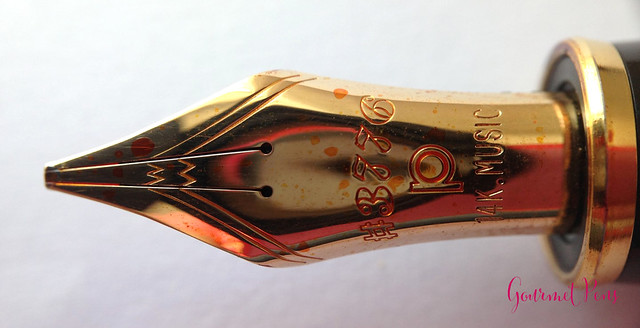 Modern: Platinum's #3776 music nib
 is designed in the traditional double slit, triple tine style, also in 14K gold. This is a nice, smooth nib that has good flow, but it isn't a gusher. It also doesn't have a very rounded, as stubby a tip like that of the Sailor so the writing experience is a little more crisp and precise, although it still offers a lot of line variation. The edges are slightly sharper than that on the Sailor, if you are looking for a nib with a little bit of a crisper feel. The nib has no flex whatsoever - it's a nail.
Check out my full Platinum #3776 + Music nib review.
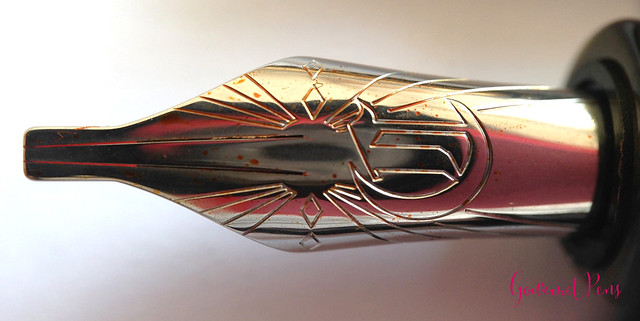 Modern: Franklin-Christoph's "Christoph" music nib is a magnificently wide nib, at 1.9 mm. It has two slits and three tines, and is a steel nib. This nib is the most affordable music nib option, in that you can purchase just the #6 nib and feed unit as one for $35USD and use it in a pen you have that accommodates #6 nibs. It's very smooth, very wet, but has no flex and is very hard.
Check out my full Franklin-Christoph "Christoph" Music nib review.
Check out Serious Nibbage Part 2 with SBREBrown, where we discuss this nib.
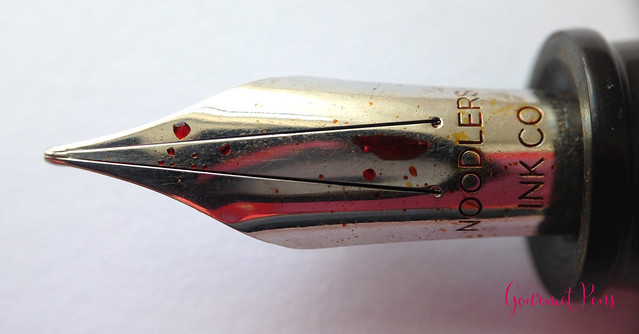 Modern: The Noodler's Neponset music nib is very innovative: it's a double slit, triple tine nib, but it's a steel nib. While the Franklin-Christoph "Christoph" music nib is also steel, the Neponset's music nib sets itself apart with its ability to flex. In fact, it sets itself apart from the Sailor, Platinum, and the Christoph music nib because of this. It's a very wet writer and the ink flow keeps up well when flexed.
Check out my full Noodler's Neponset + Music nib review.
Check out Serious Nibbage Part I: a short discussion of the Neponset with SBRE Brown.
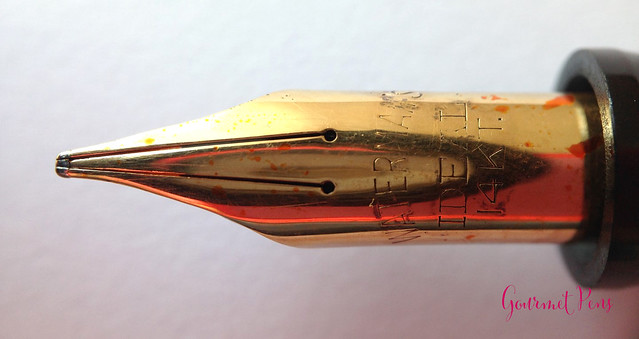 Vintage: From the vintage world, I have a single Waterman music nib that I absolutely adore. It's a 14K gold, double slit, triple tine nib. It's an insanely wet writer, and I imagine when this pen was actually made, it was made with the intent for its purchaser to actually create something musical with it (as opposed to what I actually do with it, which is basically just a shame). This is a true music nib in that it has all the qualities we want: soft, smooth edges, two slits, three tines, very wet writer, and even better, it's very flexible.
Check out my full Waterman 94 + Music nib review.
I hope this was a helpful bit of information on music nibs! Find yourself a nib that suits your tastes if you don't have one already, and enjoy it!
Ink responsibly!™
Inks, Paper, Pens
Noodler's Apache Sunset
References:
RichardsPens
RichardsPens Nibs
Do a gal a solid and if you fancy any of these and want any item of your own, use my affiliate links :)
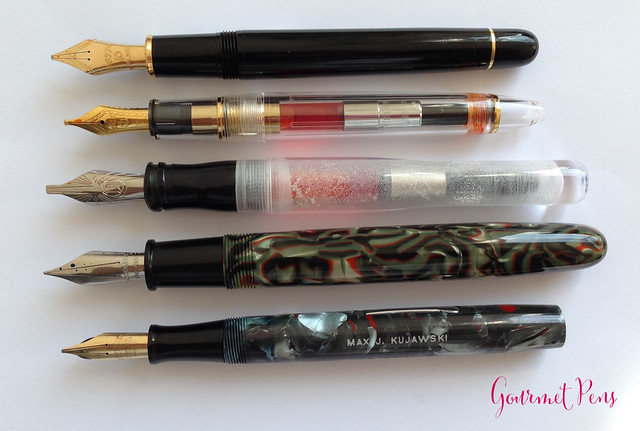 |
| Top to bottom, all with music nibs: Platinum #3776. Sailor 1911 Standard. Franklin-Christoph Model 02 Intrinsic. Noodler's Neponset. Waterman 94. |
Traditional music nibs have a broad stub tip with smooth edges. It's a nib that was made for just that: writing music. (Not composing it, mind you, just writing it down.) You'll notice that music has fat, filled in notes, and thin horizontal bars. The nibs are usually wet writers because this generous flow allows musicians to fill in those notes more easily and more quickly. Vintage music nibs were produced with two slits and three tines, and were flexible.
Two Tines, Three Tines?
Typically, we expect music nibs to have two slits and three tines because this offers a wetter flow and more line variation (wider stub), both needed for actually writing music, but this isn't a requirement, and it's possible to achieve such wetness and variation without three tines. The feeds for these nibs are often made specifically for these nibs as well, as in the case of the upcoming Noodler's Neponset, which has two slits to feed the nib with ink.
What's The Difference: Stub, Italic, Music?
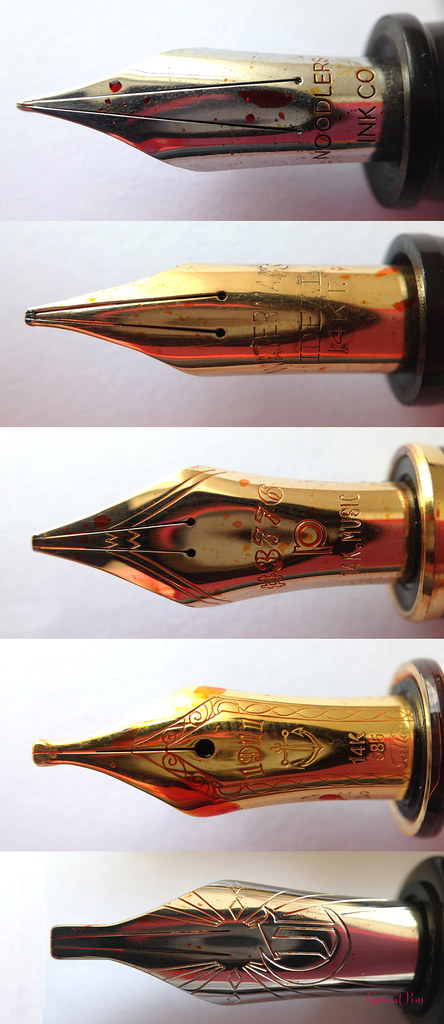 |
| Top to bottom, all music nibs: Noodler's Neponset. Waterman 94. Platinum #3776. Sailor 1911. Franklin-Christoph "Christoph". |

 |
| Image from RichardsPens |
 |
| Image from RichardsPens |
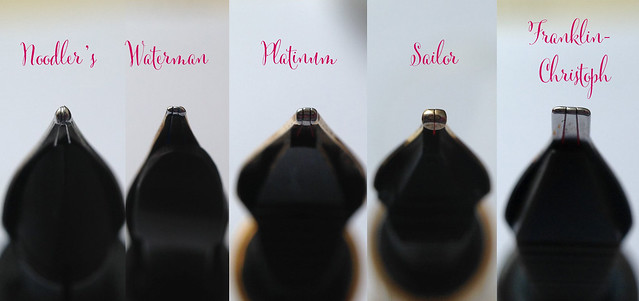 |
| Different music nib tips! Noodler's - round. Waterman - elongated. Platinum - elongated and stubby. Sailor - stubby. Franklin-Christoph - elongated. |
Music nibs are often used at very high angles relative to the paper, where down strokes would be thin, and side strokes would be the width of the nib. This is probably the opposite of what you expect from a stub/italic nib, whose down strokes are thick and side strokes are thin.
In addition, stubs/italics frequently have sharp corners and edges where the rounded bottom of the tines meet the flat top of the tip. If one tries to write music with an italic, rotating/holding the pen as musicians often do when scribbling notes and bars would dig into the paper.
True music nibs should have smoothed edges so the nib glides across the page, even if the pen is rotated, and at both high and low angles of writing.

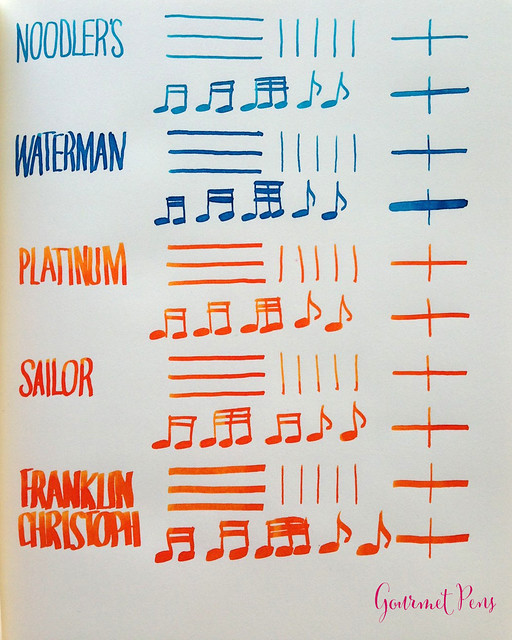 |
| Music nibs line widths, with proper music nib grip. First + with no pressure, second + with pressure. Note the Noodler's and Waterman have flex, and the Platinum, Sailor, and Franklin-Christoph do not. |
If you've ever tried to write music, or even just draw notes, you'll notice it's a heck of a lot more difficult (and irritating) to try and draw them with a hard, unyielding nib. Music nibs with flexibility is a modification that allows the nib to flex on the pull stroke to widen/wetten/thicken notes and lines - such as notes and note bars. It may not be a requirement, but a nib without flexibility will hamper the ability to quickly and easily write music.
A nib without flexibility isn't less enjoyable though. They can still offer some great line variation and a wonderful writing experience, especially if you aren't using it for actually writing music.
Want A Music Nib?
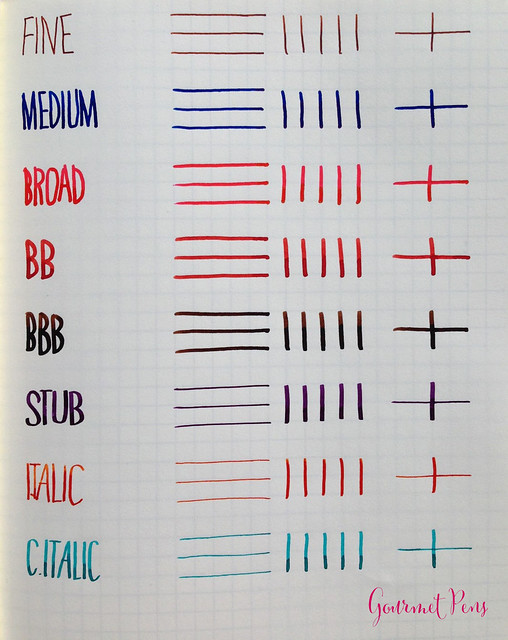 |
| Standard nibs lines with normal grip. |
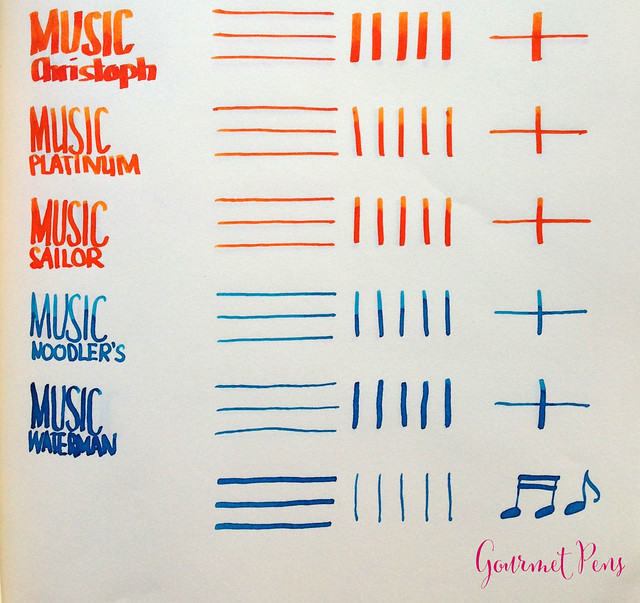 |
| Music nibs line widths, used normally (not at "music nib angle"), except for bottom row of Waterman music nib, where I use the nib with proper music nib grip, to show the difference. |
is a single slit, double tine music nib in 14K gold. This nib offers the wide stub needed for filling in notes, with the ability to draw thinner, horizontal lines for the note bars. It's also meant to be a wet writer. The tip of this nib is very stubby and even if you're not a musician, it offers a wonderful, expressing writing experience with bold lines. The edges are also fairly smooth so it doesn't catch on the page easily. It has no flex. is designed in the traditional double slit, triple tine style, also in 14K gold. This is a nice, smooth nib that has good flow, but it isn't a gusher. It also doesn't have a very rounded, as stubby a tip like that of the Sailor so the writing experience is a little more crisp and precise, although it still offers a lot of line variation. The edges are slightly sharper than that on the Sailor, if you are looking for a nib with a little bit of a crisper feel. The nib has no flex whatsoever - it's a nail.Check out Serious Nibbage Part 2 with SBREBrown, where we discuss this nib.
Check out Serious Nibbage Part I: a short discussion of the Neponset with SBRE Brown.
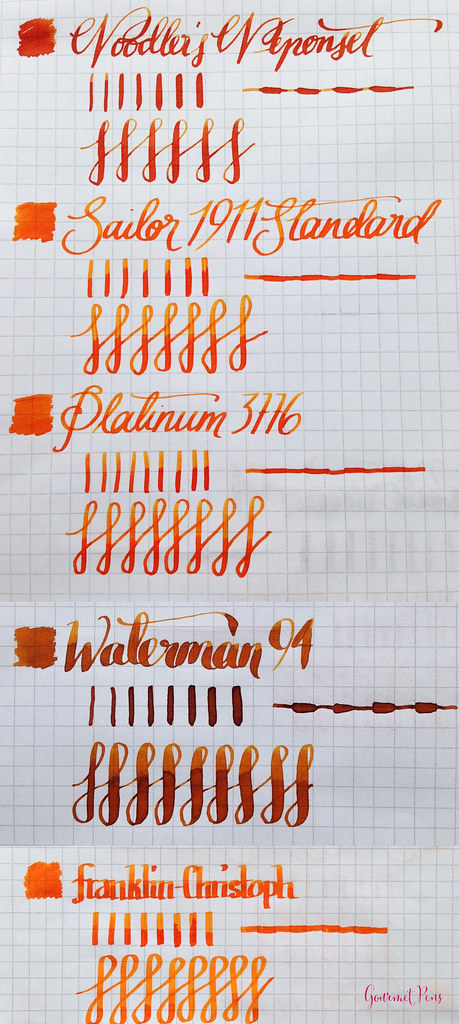 |
| Music Nibs with normal grip. Lines with increasing pressure | | | | Testing responsiveness of nib ------ Loop-the-loops - line variation in writing. |
Ink responsibly!™
Inks, Paper, Pens
Noodler's Apache Sunset


RichardsPens
RichardsPens Nibs
Do a gal a solid and if you fancy any of these and want any item of your own, use my affiliate links :)
Thursday, September 18, 2014
Review: Waterman 94 Steel Quartz Fountain Pen - Music Nib
Interesting note about this pen: a Private Detective ran the name engraved on the pen: Max J. Kujawaski. This PD is fairly certain that Max last lived in Wausaukee, WI, born 01/04/1885, died 04/1974.Of course, if this is true, it's just really neat to know this. If it isn't true... well. It still adds some fun mystery to the pen, doesn't it? Max had good taste. Let's have a look at his pen!
 If you don't feel like reading everything, just scroll for pictures. And some videos of writing samples at the bottom (from my YouTube). Also follow me on Instagram because I post this pen/writing pretty often.
ABOUT
Brand: Waterman
Model: 94
Body Material: Celluloid
Trim: Nickel
Origins: Made in USA, 1930s
Length (capped): 5.0"
Length (uncapped nib-end): 4.73"
Length (posted): 6.42"
Barrel Diameter: 0.47"
Section Diameter: 0.33" - 0.40"
Nib type: Waterman Ideal #5
Nib material: 14K Ideal Music
Weight: 14g
Fill type: Lever filler
Price: Price will vary
Where to buy: VintagePen.net (this is where I bought mine; you can always look elsewhere!)
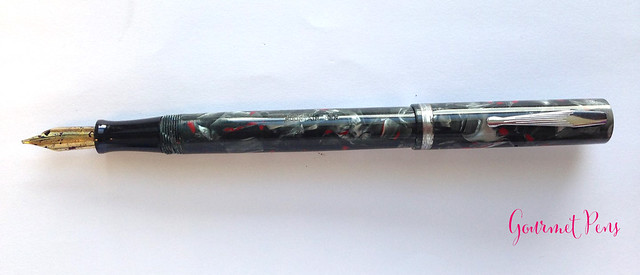 PACKAGING
It is unusual that vintage pens come with their original packaging. In this case, the Waterman 94 does not come with its packaging. Don't care. Just wanted to get to the nib. Onward ho!
APPEARANCE
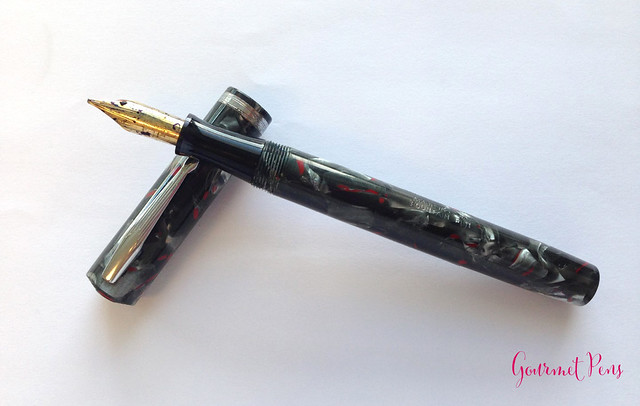
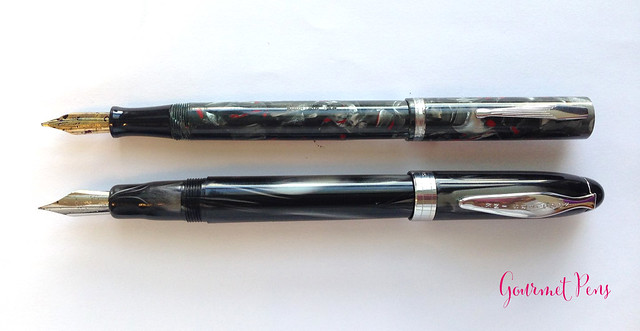
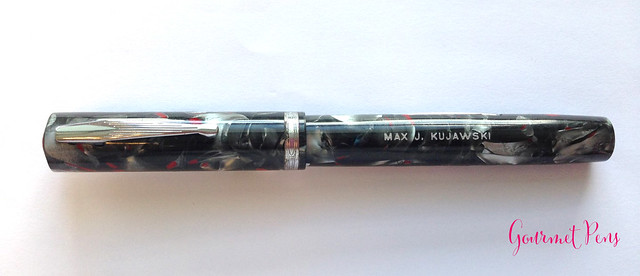 This Waterman 94 is a fairly large pen, compared to the other vintage Waterman pens I have. It is in the Steel Quartz finish- a shimmery marbled silver-grey celluloid with red flecks in it. There is a silver clip, center and, and lever (the trim is nickel). The finial is the same material and is raised to a center in concentric rings. Uncapped, the section is small, smooth, and flares towards the nib. It is black but looks great with the grey and red body. The threads are the same colour as the barrel.
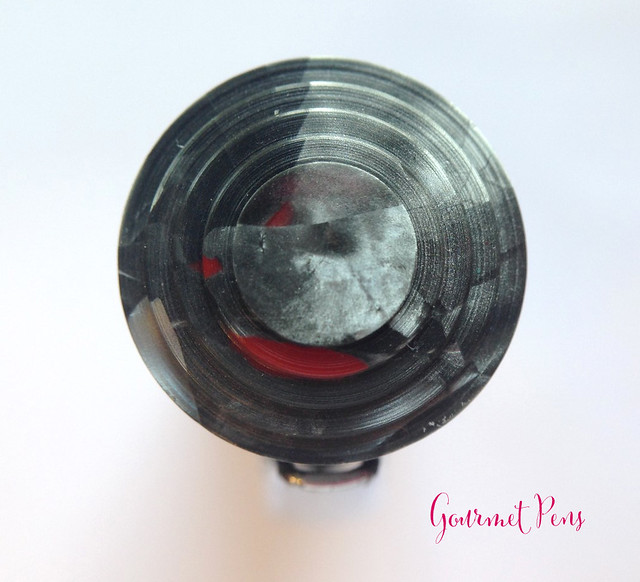 This particular pen is engraved with the name of Max J. Kujawski. The Waterman imprint is no longer white (assuming it was once white) but it is still visible.
 NIB & PERFORMANCE
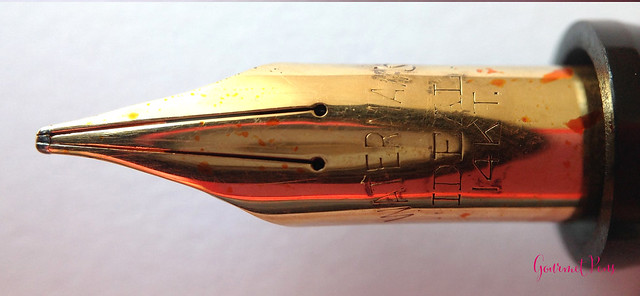 This nib is a large, beautiful 14 karat gold three-tined music nib. It says Waterman's Ideal 14KT. It's pretty simple. The two tines on the side are thinner than the middle tine: the tine in the middle is visibly wider. The slits are at a semi-diagonal and there are two breather holes. All three tines are flexible. I'm certainly not a professional but the nib feels like a super flex to wet noodle. The center tine is less flexible than the side tines, so the flexibility may be limited by the center tine. The tines on the side are easier to flex (require less pressure) but of course are far more delicate and require a lot more attention and care.
How does this wonderful nib perform? Well, wonderfully! It was set up to be an ink guzzler, and it certainly guzzles ink! I don't know how much ink it holds because I've never measured, but I do expect that when I ink it, it won't be long before I'm re-inking it, and I basically just "practice" and doodle with it.
I absolutely adore this pen and nib. The section has a crack and when I discovered it, I was devastated - something that would not bother me on any other pen, probably not even on a Nakaya (which I love, but am not crazily attached to). The nib is not hot knife through butter smooth to write with, but it isn't scratchy to use either. It does write smoothly and it doesn't catch on the paper.
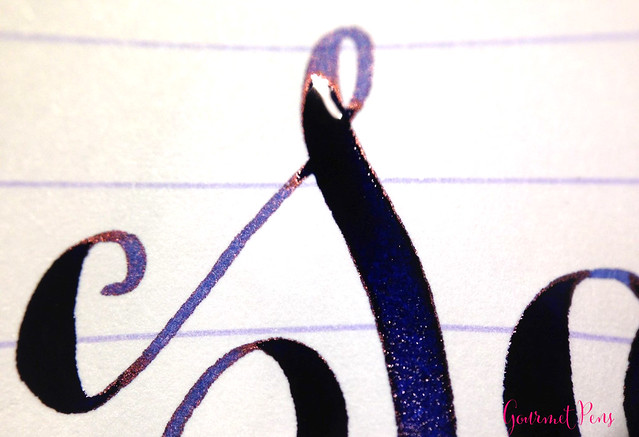
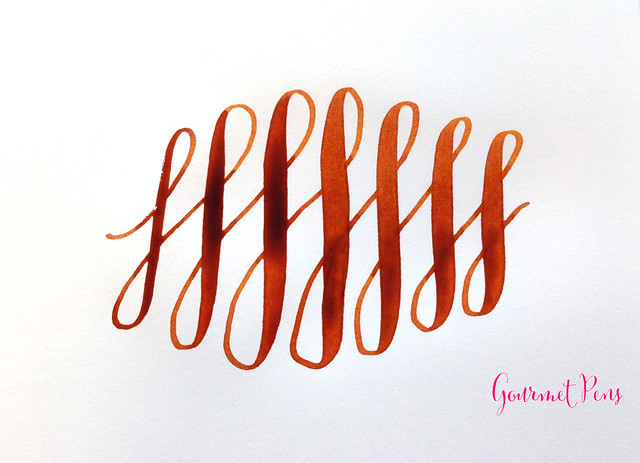
It has extreme line variation and is a very responsive nib. The side tines snap back faster than the middle tine, presumably because they are thinner than the center tine, however, overall, the entire nib is still very responsive.
I never feel I am slowed down by the snap back. The line variation comes from both the fact that the nib itself is somewhat a stub nib, and also because of the (very obvious) extreme flexibility it has. Lines vary from 1.5mm to over 3mm vertically, and 0.5mm horizontally.
You may have noticed I adore this nib. Sometimes, if I'm not paying attention to my writing, I'll make a bad stroke and the nib will railroad or a tine will pop out of place a little (I have NOT sprung the nib) - fortunately, it's easy just to slip it back into place. All that happens is one of the side tines slip over the center tine, usually on the side that a bad angle has been placed on. As for ink flow: the feed keeps up incredibly well. It can railroad, despite being set up as a wet writer, but the nib demands a lot of ink. Slow and steady.
I recently reviewed the Noodler's Neponset fountain pen that has a modern steel music nib that is indeed flexible. There, I provided some comparisons with other modern music nibs. Have a look again, if you're interested.
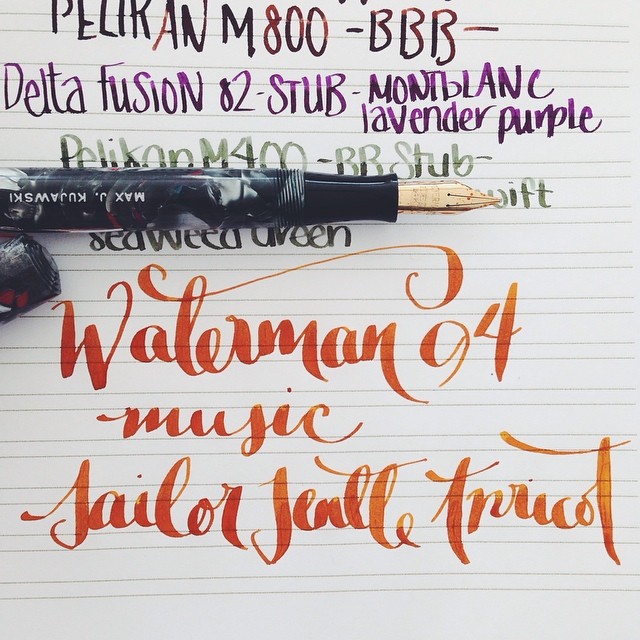
I love using it because it makes all inks look incredible: shading, sheen, wetness.
 IN HAND
In hand, this pen is light and comfortable. It's not at all a heavy body. I tend to use it unposted because it can be long, although not heavy, when posted.

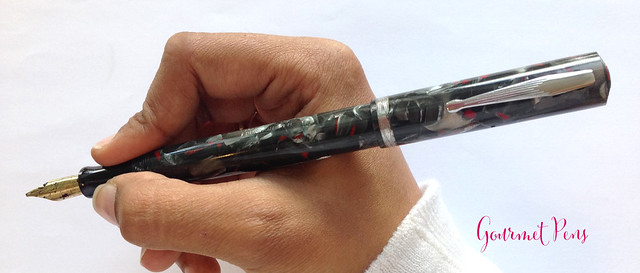 However, because of the nib, it's not exactly a pen you use to write with for hours. I imagine that, having a music nib, it was used for writing music, which is an intermittent thing, not something steady like letter writing. This matters because one must consider the design of the nib when writing with it. It takes a lot of control to write with this nib without misaligning the tines, and that can be tiring on the hands (and it requires some concentration). While the pen itself is easy to write with because it's light and comfortable to use, the nib itself requires more effort. Make sense?
PROS & CONS
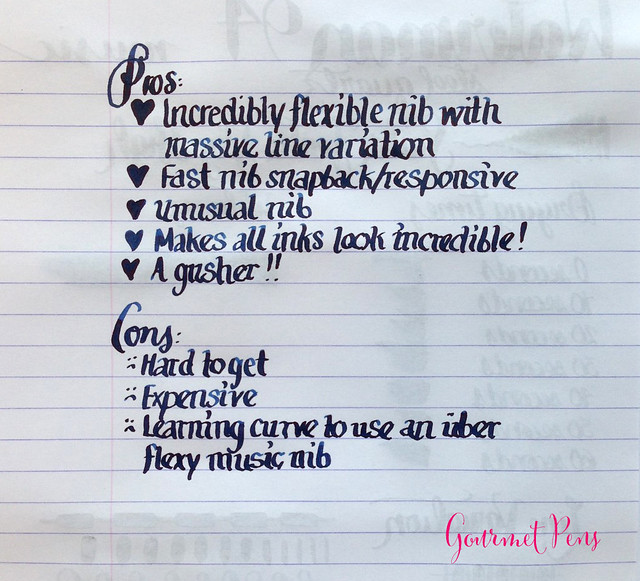 OVERALL
All that said... it's a simple delightful nib to experience. I highly doubt everyone would enjoy a nib like this because of the care, precision, and delicacy it requires, not to mention the steep cost. It's not a daily writer (well, not for most people anyway), even though I have it inked almost constantly. It makes me feel better about myself when I use it. Seriously. I feel like I am artistic (I'm not), creative (I'm not), and far more capable of pretty writing than I actually am. A pen that makes me feel that way is definitely worth it. I am so happy I came across this pen. I cannot recommend a vintage music nib to others because such a nib is very particular, but for me? It's perfect.
VIDEOS!
ABOUT
Brand: Waterman
Model: 94
Body Material: Celluloid
Trim: Nickel
Origins: Made in USA, 1930s
Length (capped): 5.0"
Length (uncapped nib-end): 4.73"
Length (posted): 6.42"
Barrel Diameter: 0.47"
Section Diameter: 0.33" - 0.40"
Nib type: Waterman Ideal #5
Nib material: 14K Ideal Music
Weight: 14g
Fill type: Lever filler
Price: Price will vary
Where to buy: VintagePen.net (this is where I bought mine; you can always look elsewhere!)
It is unusual that vintage pens come with their original packaging. In this case, the Waterman 94 does not come with its packaging. Don't care. Just wanted to get to the nib. Onward ho!
APPEARANCE
How does this wonderful nib perform? Well, wonderfully! It was set up to be an ink guzzler, and it certainly guzzles ink! I don't know how much ink it holds because I've never measured, but I do expect that when I ink it, it won't be long before I'm re-inking it, and I basically just "practice" and doodle with it.
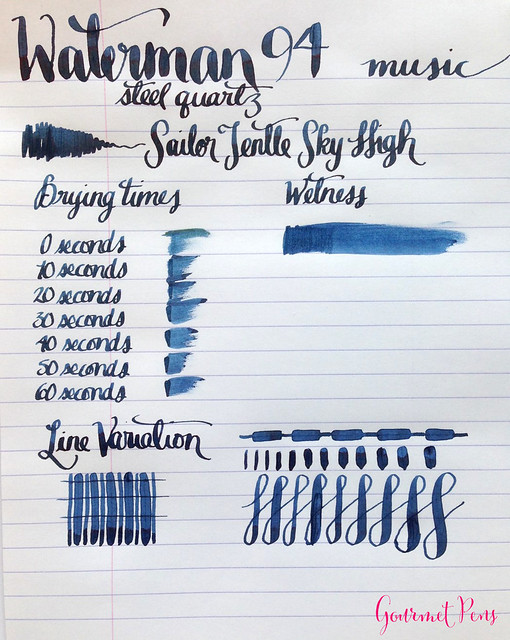 |
| This is indeed Sky High the nib and feed needs to come out for some serious cleaning, because it's a lot darker than Sky High usually is. Sorry for the inaccurate ink colour. |
It has extreme line variation and is a very responsive nib. The side tines snap back faster than the middle tine, presumably because they are thinner than the center tine, however, overall, the entire nib is still very responsive.
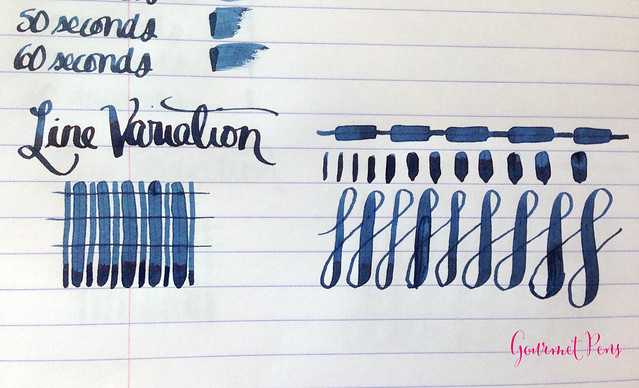 |
| That is some serious line variation. |
 |
| You can see right in the middle where I made a bad stroke and the line went wonky. |
I recently reviewed the Noodler's Neponset fountain pen that has a modern steel music nib that is indeed flexible. There, I provided some comparisons with other modern music nibs. Have a look again, if you're interested.
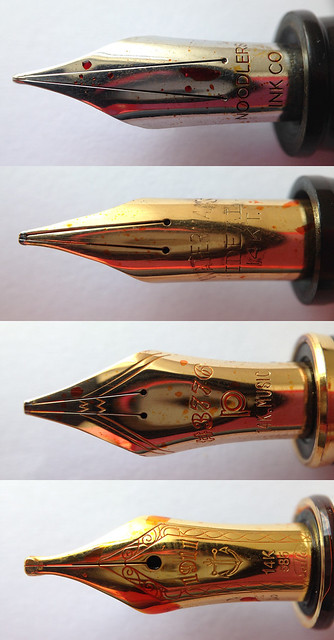 |
| Noodler's Neponset Music Nib. Waterman 94 + Ideal Music Nib. Platinum 3776 Music Nib. Sailor 1911 Standard Music Nib. |
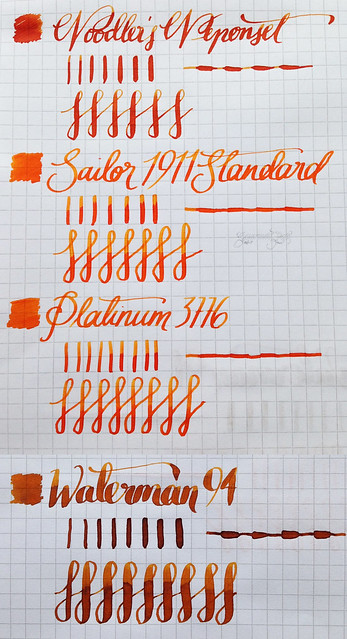 |
| Inks from top to bottom: Noodler's Apache Sunset , Sailor Jentle Apricot, Sailor Jentle Apricot, Sailor Jentle Apricot mixed with ... well. Something. |
In hand, this pen is light and comfortable. It's not at all a heavy body. I tend to use it unposted because it can be long, although not heavy, when posted.
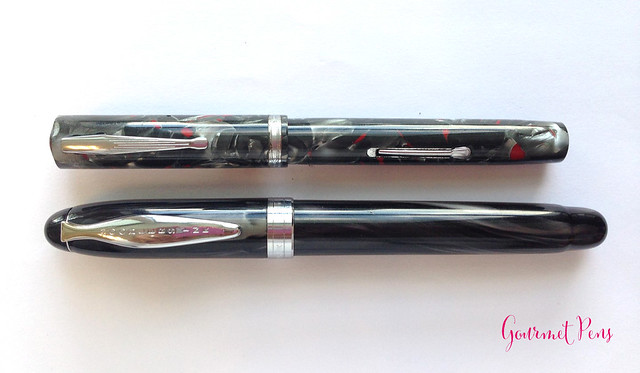 |
| Pictured with a Noodler's Ahab. (Thanks Peter!) |
 |
| Pictured with a Noodler's Ahab. (Thanks Peter!) |
All that said... it's a simple delightful nib to experience. I highly doubt everyone would enjoy a nib like this because of the care, precision, and delicacy it requires, not to mention the steep cost. It's not a daily writer (well, not for most people anyway), even though I have it inked almost constantly. It makes me feel better about myself when I use it. Seriously. I feel like I am artistic (I'm not), creative (I'm not), and far more capable of pretty writing than I actually am. A pen that makes me feel that way is definitely worth it. I am so happy I came across this pen. I cannot recommend a vintage music nib to others because such a nib is very particular, but for me? It's perfect.
VIDEOS!
Note: Some information has been sourced from my "dealer" - Mauricio at VintagePen.net! A huge thank you to Mauricio for parting with this pen because it's without a doubt one of my babies.
Need The Inks?
Rohrer & Klingner - Alt-Goldgrün
Pilot Iroshizuku Kiri-Same Misty Rain
Pilot Iroshizuku Kon-Peki Deep Azure Blue (Deep Blue)
Do a gal a solid and if you fancy any of these and want any item of your own, use my affiliate links :)
Need The Inks?
Rohrer & Klingner - Alt-Goldgrün
Pilot Iroshizuku Kiri-Same Misty Rain
Pilot Iroshizuku Kon-Peki Deep Azure Blue (Deep Blue)
Subscribe to:
Posts (Atom)








 Posts
Posts


